Decision-making models
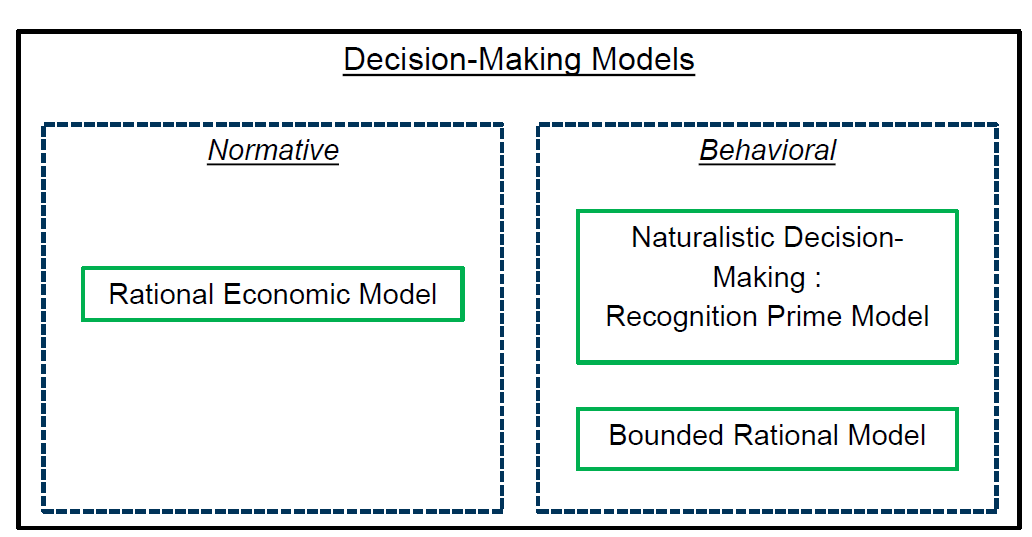
FrameworkThe decision-making process consists of a series of steps made by the people in charge of architecting the system design. Attempts have been made to represent the series of steps through various decision-making models. In general, decision-making can be classified broadly into two streams: normative and behavioral. Within the scope of this thesis, the models investigated in detail under each stream are presented in the diagram above.
The models falling under the normative stream are based on sound logical reasoning and statistics, and are applicable mostly in an ideal-world scenario where a perfect requirements document with no future changes is available, alongside ideal time, budget, team and other factors. One such model is the Rational Economic Model (REM).
The models falling under the behavioral stream are subject to cognitive limitations and are normally the ones we observe in real-world scenarios. Two models of interest are the Recognition Primed Model (RPM), which is a representation of naturalistic decision-making, and the Bounded Rational Model (BRM).